My Top 5 Creativity Mantras and Why They Matter
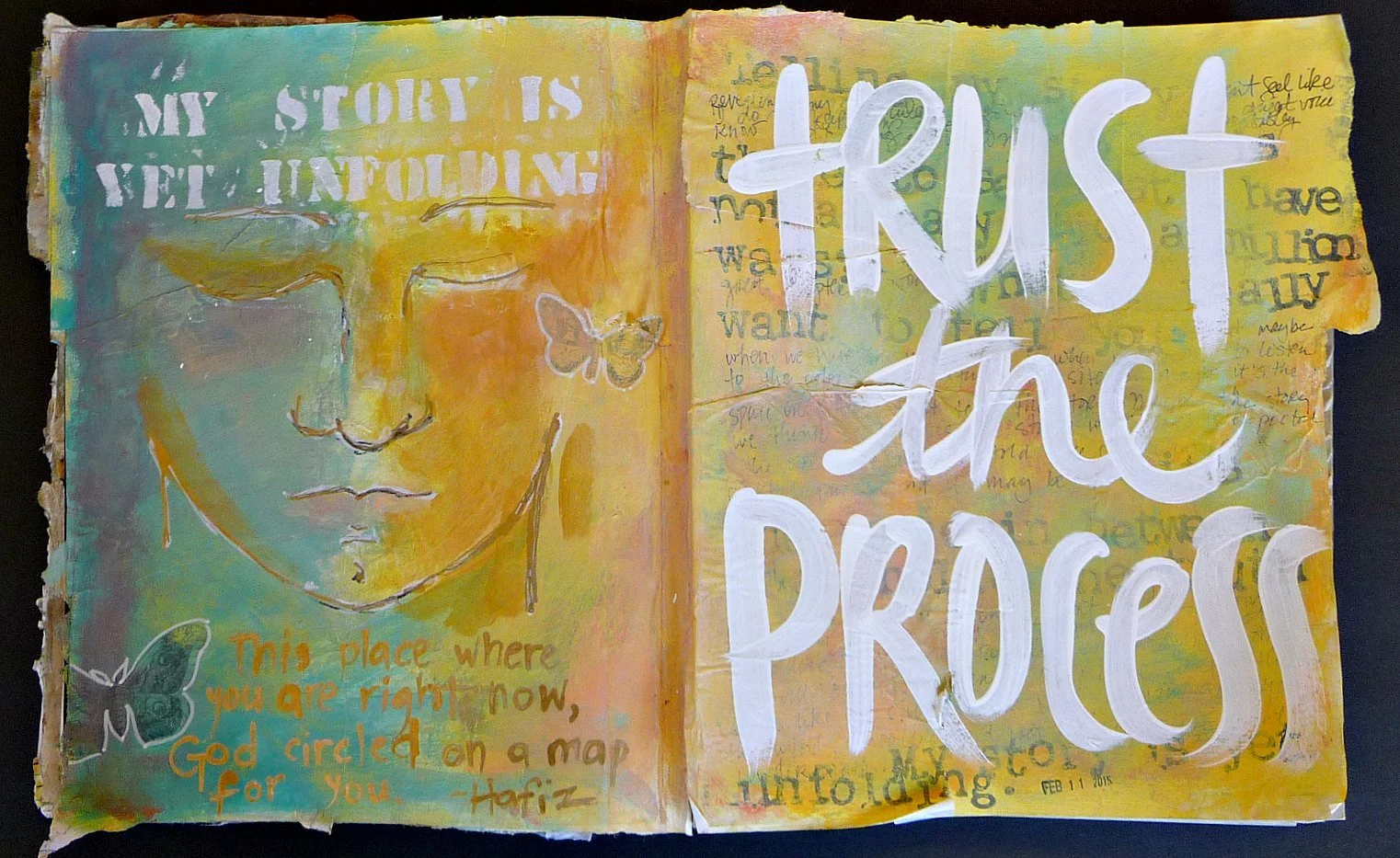
©Susie Stonefield 2015
In my work with private creativity coaching clients and students of my deep dive group programs I always share my top five creativity mantras. These are teachings that I put in front of myself when I’m creating. They are potent lessons in presence, patience, surrender, and forgiveness. And when I bring them to my creative practice—in fact, when I bring them to my LIFE—I reap benefits.
I invite you to take each mantra and write it on a small card (index card or 4x4” card) and post on your bulletin board or wall above your art-making space.
1. Trust the process.
This is key.
The creative process can be very uncomfortable. It can be confusing. If you are being totally open during your creativity you may have absolutely no idea what it’s about, why certain things are showing up on the page. You may want to stop. You may want to throw it away.
That’s all wonderful! Keep going!
The creative process is a journey. It is an unfolding. It is all about what takes place on the page between starting and finishing. It is not about the final product as much as it’s about what happened while you were working. How you felt, how you moved, what showed up, what surprised you. Any insights that surfaced.
Trusting the process means that even when there is struggle you persist in the creative act, trusting that there is some reason you are feeling that way, some reason it looks the way it does, some reason the page is taking shape in the way it is.
INVITATION: Just keep leaning into the work! Make a “Trust the Process” page and put it up on the wall to remind yourself how important the process is!
2. Let go of your expectations.
We all come to the page with expectations.
Of who we tell ourselves we are and we aren’t (“I am an artist” or “I’m not an artist”)
Of what we think this is supposed to be or isn’t supposed to be (“This is supposed to be a beautiful work of art” or “This isn’t supposed to look like a kindergartner made it!”)
Of how this is supposed to feel (“This is supposed to feel easy,” “This is supposed to feel cathartic,” or “This is supposed to feel fun.”)
These expectations will keep interfering with your process. So as you notice them arise in your consciousness, just let them go. Imagine them floating off into the atmosphere.
INVITATION: Start with a warm up practice. This is like a musician doing scales to warm up her vocal cords. Have a warm up art journal that you work in every session before you do the “real work.” Scribble, splatter, sponge, fingerpaint on the page. Set a timer and give yourself a good 10 minutes or more to just play with art supplies. It really will limber up your Inner Artist and remind you how good it feels to work without any plan for the end of the piece or the meaning of the piece. When you’re ready to dive into your other journal. Keep allowing yourself to have the open space to just BE in your creative process.
3. Get out of your head. Get into your heart. Get onto the page.
The more we can make room for the wordless part of our spirits to come forth, the more we can learn from our deep, innate, inner wisdom. But to do that we need to quiet our minds. And our minds are not inclined to be quieted.
INVITATION: Approach art journaling like a meditation. Focus on your breathing and your heart. As your mind starts to interfere, just notice you are thinking and bring your attention back to your breath, the paint on the page, and your emotions.
4. Expect your Inner Critic to show up . . . and show it the door.
The inner critic does not play nice.
Our inner critic always wants to protect us from taking risks. Being creative and vulnerable is definitely taking a risk. So, when your inner critic taps you on the shoulder (or, more likely, barges into your art making space) to remind you that you shouldn’t be doing this or it should look better or you don’t know what you’re doing, tell it to go play in the hall, you’re not playing with it now.
INVITATION: Make a portrait of your inner critic. Write down all the terrible things it says to you. It’s quite liberating seeing all the horrible insults in one place. It’s like shining a light on your “monster under the bed.” You wouldn’t say those things to your worst enemy, so why should you say them to yourself? You can pull that inner critic portrait page out of your art journal and put it in the hall where your inner critic can admire itself every time you get ready to create!
5. You never know where the mess will take you.
There is always a messy middle of the creative process. Discomfort is part of it!
There will likely come a point in which you feel dissatisfied or uncomfortable or even completely disgusted with what is happening on the page. This is the mess and it’s just a part of the process. It’s a sticky place you need to keep working through while keeping faith in the process.
I can’t tell you the number of times I’ve hit that messy middle and pushed through only to find myself with an art journal page I never could’ve envisioned and some deep personal insights I didn’t know were inside me.
INVITATION: Allow yourself to feel the discomfort. Keep working. OR, take a break from the page and do another one. OR, turn your book upside down and work in a completely different way. OR turn the page and move on. You can always return to this page when you are feeling less attached or triggered by it. It may be that the Universe is planning something really important for that page, but you just don’t know what it is right now. Trust that and give it time to percolate. I highly recommend NOT tearing pages out of your art journal, however.
Why do these mantras matter?
We all have narratives that are the refrains of our lives. These are the stories we tell ourselves about ourselves that have followed us from childhood. For better or worse (usually worse), they impact our choices—our yeses, noes and maybes—and our responses in various circumstances.
In regards to art making and the creative process, some of those narratives are so common they might be cliches. “I’m not an artist” and “I don’t know how to draw a straight line” come to mind.
I have heard so many narratives about creativity and art making through my decade in the studio. These narratives negatively impact the work and the process. They are limiting beliefs and they hold us back in discovering ourselves, especially if they keep us from doing the work.
“It’s not worth my time.”
“What’s the point of doing this?”
“It doesn’t look like I imagined.”
“Art is only for artists.”
“I’m not creative.”
“I don’t know how to do this.”
“I can’t do this.”
“It needs to look more ……………………………….. (refined, professional, finished, legible, beautiful).”
One way to release these negative stories is to actively replace them with my positive Creativity Mantras.
I don’t know what I’m doing. I might as well give up. ➡➡➡ Trust the process.
I can only make what I’m planning to make. It’s too scary to work from an open place with no plan. ➡➡➡ Let go of your expectations.
I’m afraid to no ➡➡➡ Get out of your head, into your heart and onto the page.
I believe that voice that tells me I’m no good. ➡➡➡ Expect the inner critic to show up . . . and show it the door.
I hate this mess. I have to throw away my work when it gets messy like this. ➡➡➡ You never know where the mess will take you.
The more you do this, the more you realize that the creative space is a space place for you to explore. And the safer you feel, the easier it is to notice when you’re feeling negative and shift your thinking. Ultimately, it’ll get pretty automatic.
And THAT is changing your narrative! Yes!
I invite you to bring the creativity mantras into your life and see how they change your experience of art making!